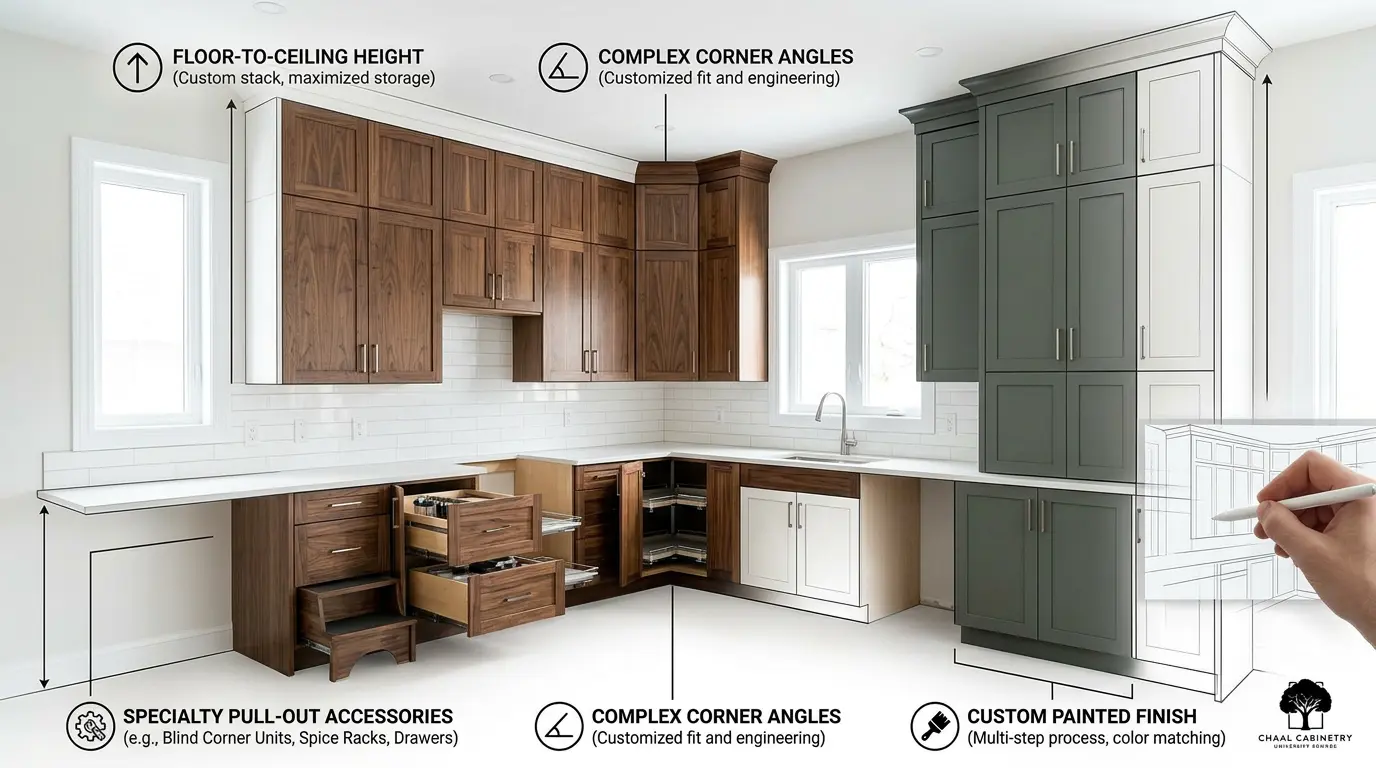
Complex layouts with many corners or angles, premium wood species such as walnut or cherry, painted finishes (which require more labour steps than stained), tall or deep cabinetry, specialty storage accessories, material upgrades like HDF doors or plywood boxes, and detailed finish work all add cost. Drawer-heavy layouts also cost more than door-and-shelf designs.
The biggest cost increases usually come from complexity. That can mean:
– Premium wood species (walnut, cherry) vs. maple or birch
– Painted finishes (more labour steps than stained)
– Material upgrades—choosing plywood over particleboard, or HDF over standard MDF
– Lots of drawers (more precise construction and hardware)
– Specialty storage accessories and organizers
– Taller or deeper cabinetry
– Detailed finish work
– Complex layouts with more corners, angles, or custom sizing
Some upgrades add cost because of materials, while others add cost because of labour. For example, a painted finish often takes more preparation and finishing work than a stained one. A drawer-heavy layout usually costs more than a door-and-shelf layout because of the added hardware and construction.
Material choices within the engineered wood category also affect cost. Choosing HDF doors instead of standard MDF might add $500-$2,000 to a full kitchen, depending on the number of doors. That upgrade is usually justified when you’re in a high-moisture area or planning for long-term durability, but it’s worth understanding the cost-benefit trade-off for your specific situation.
Understanding those cost drivers helps homeowners make better decisions. It gives you a clearer sense of where to invest and where it may make sense to keep things simpler.